Washington, D.C.
RE: FEBRUARY 2026 MHARR — ISSUES AND PERSPECTIVES — A MUST READ
Attached, please find your copy of the February 2026 MHARR — ISSUES AND PERSPECTIVES article entitled, “WHY MANUFACTURED HOUSING PRODUCTION REMAINS SUPPRESSED – AND WHAT COULD CHANGE IT”
Thank you
Attachments
Manufactured Housing Association for Regulatory Reform (MHARR)
1331 Pennsylvania Ave N.W., Suite 512
Washington D.C. 20004
Phone: 202/783-4087
Fax: 202/783-4075
Email: MHARRDG@AOL.COM
Website: www.manufacturedhousingassociation.org
MHARR — ISSUES AND PERSPECTIVES
By Mark Weiss
FEBRUARY 2026
“WHY MANUFACTURED HOUSING PRODUCTION REMAINS SUPPRESSED – AND WHAT COULD CHANGE IT”
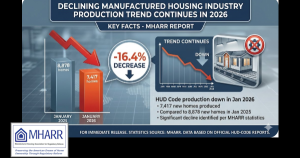
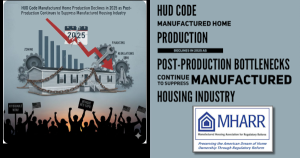
Despite a national housing affordability crisis and a federal administration committed to a policy of lesser (and less burdensome) federal regulation and greater housing supply, the manufactured housing industry continues to underperform. The problem is not manufacturing capacity or consumer demand, but rather a set of unresolved post-production bottlenecks that have constrained the industry for decades.
At the core of the problem are two structural failures: discriminatory zoning exclusion and the non-implementation of the most crucial aspect of the federal Duty to Serve (DTS) mandate for manufactured home consumer loans. Together, these barriers limit where manufactured homes can be placed and how they can be financed, sharply suppressing production and sales of the industry’s most affordable homes.
Zoning Exclusion: A Key Federal Tool Left Unused
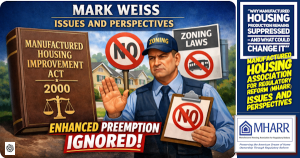
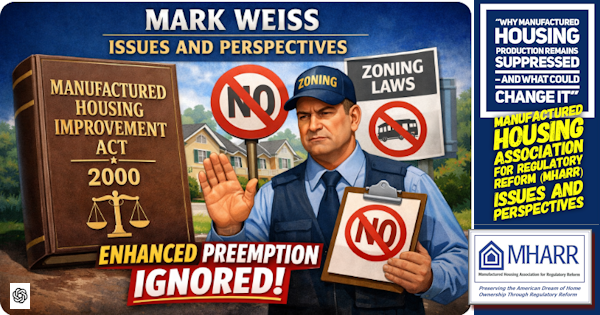
The Manufactured Housing Improvement Act of 2000 strengthened federal preemption over state and local “requirements” affecting HUD Code homes. Congress explicitly directed that this preemption be “broadly and liberally construed” to facilitate affordable housing and homeownership. Yet, HUD has consistently failed to assert this authority against local zoning ordinances that exclude manufactured homes while allowing site-built housing.
The result is a paradox: manufactured homes are federally regulated for construction and safety, but are still barred from many communities by local land-use rules. This type of discriminatory exclusion directly conflicts with congressional intent and HUD has both the authority and obligation to intervene—if necessary through litigation—to eliminate discriminatory zoning practices.
Financing Failure: Duty to Serve in Name Only
The second bottleneck is the failure of Fannie Mae and Freddie Mac to fully implement DTS, enacted after the 2008 financial crisis to expand credit access in underserved housing markets, including manufactured housing. While the statute clearly includes both real estate and personal property (chattel) loans, the Government Sponsored Enterprises have ignored chattel lending, which accounts for more than 70 percent of manufactured home purchases.
Instead, DTS implementation has focused on higher-cost manufactured homes titled as real estate, including so-called “MH Select” and “cross-mod” homes (among others). This leaves mainstream buyers — often lower-and moderate-income individuals and/or families — dependent on a small number of portfolio lenders, resulting in higher interest rates, reduced competition, and fewer qualified buyers. This failure not only violates both the spirit and letter of DTS, but systematically disadvantages the most affordable segment of the housing market.
Legislative Distraction: Fixing Yesterday’s Problems
A further problem lies in current industry advocacy priorities, particularly support for the pending “ROAD to Housing Act” in the senate and parallel legislation in the House. While those bills would remove the long-standing permanent chassis requirement and clarify HUD’s authority over construction standards, including so-called “energy” standards, they do not address zoning exclusion or DTS noncompliance—the issues that most directly suppress production.
Focusing on these “low-hanging” reforms risks giving the appearance of progress while leaving the industry’s core constraints untouched. Even if enacted, such legislation would likely benefit higher-priced, non-mainstream HUD Code homes and dominant industry lenders, while doing little to expand access to genuinely affordable mainstream manufactured housing.
Energy Standards: An Additional Cost Burden
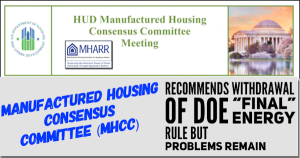
Compounding these challenges are U.S. Department of Energy (DOE) energy standards for manufactured housing, which the statutory Manufactured Housing Consensus Committee (MHCC) has confirmed, are excessive and discriminatory, as well as the product of a flawed regulatory process. The DOE standards would significantly increase home purchase costs for consumers who already rely on manufactured housing for affordability—despite evidence that manufactured homes already perform well on energy efficiency metrics. As a result, DOE’s constant underlying threat to implement these excessively costly standards (and related enforcement mechanisms) significantly compounds consumer anxiety within the mainstream HUD Code manufactured housing market, ultimately leading to reduced sales and production.
The Bottom Line
The stagnation of the HUD Code manufactured housing industry is not inevitable. Federal law already provides the tools needed to expand placement, improve financing access, and boost production, as well as the development of new and expanded manufactured housing communities. What is missing is the political will and industry post-production representation necessary to demand the enforcement and full, robust implementation of those laws.
Until zoning discrimination is challenged, DTS is fully implemented for consumer chattel loans, and unnecessary regulatory costs are rolled back, manufactured housing will continue to fall short of its full potential to provide hundreds-of-thousands of new homes each year, as a scalable, affordable housing solution — despite an unprecedented affordable housing crisis and a desperate need that it could readily solve.
Given the failure of the housing bills pending in the House and Senate at press time to directly address discriminatory zoning exclusion and/or DTS non-implementation within the dominant chattel financing market, MHARR has developed and released (on September 8, 2025) statutory amendments to address and remedy both of these key issues. The Manufactured Housing Institute (MHI) (i.e., the industry’s post-production national representation), however, has yet to give any public or private indication (that MHARR is aware of) that it would support – or has supported — the inclusion of these additional provisions, which are absolutely essential to breaking the regulatory logjam that has suppressed the industry and the availability of truly affordable housing and homeownership for far too long.
Time is of the essence, though, as MHI and the entire industry should now seek to include these crucial amendments in the housing bill ultimately put before a House-Senate conference committee, which will decide the language and structure of any final bill.
Mark Weiss
MHARR is a Washington, D.C.-based national trade association representing the views and interests of independent producers of federally-regulated manufactured housing.
“MHARR-Issues and Perspectives” is available for re-publication in full (i.e., without alteration or substantive modification) without further permission and with proper attribution to MHARR.