Washington, D.C. – June 2026.
“PENDING HOUSING LEGISLATION IS A LITANY OF DEFICIENCIES AND
MISSED OPPORTUNITIES FOR MAINSTREAM MH AND CONSUMERS”
By Mark Weiss
As work continues in Congress (at press time) to produce an impactful “housing” bill, in the face of an unprecedented shortage of affordable housing and homeownership opportunities – a scenario which should present a wealth of opportunities to promote and advance the availability and utilization of inherently affordable HUD-regulated mainstream manufactured housing — the industry is simultaneously being sold short and led down a “Primrose Path” by one of the chief industry proponents of that legislation, the Manufactured Housing Institute (MHI).
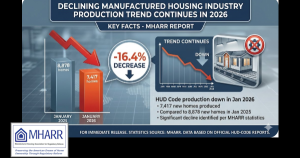
What would the proposed “housing” bills “do” for mainstream HUD Code manufactured housing? And for mainstream manufactured housing consumers? The bills – which contain differing provisions in the House and Senate versions that will need to be reconciled before ultimate passage by both houses — incorporate major deficiencies and lost opportunities for the industry and for all those who rely on manufactured housing as the nation’s premier source of affordable homeownership. In part, this reflects the reality that manufactured housing-related provisions of the bills were apparently developed and negotiated (with corresponding concessions and compromises) by MHI (and others) behind closed doors with no independent industry input. It appears, though that MHI either lost control of that process – or never had it at all – ultimately leading to bills that are highly deficient. Given this secretive process, it is apparent — and also not surprising — that many within the industry have no real conception of what is actually in the bills regarding manufactured housing, what the “on the ground” impact of those provisions would likely be and, even more importantly, what is not in the bills but should be there, needs to be there, and, in reality, must be there if the industry is to expand and prosper against a backdrop of historically weak production (i.e., annual average production of 78,117 new manufactured homes per year from 2011-2025) and comparably weak or non-existent production growth.
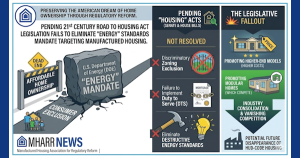
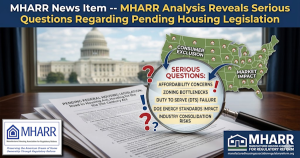
The over-arching deficiency of the pending bills – the “21st Century ROAD to Housing Act” in the Senate and the “Housing for the 21st Century Act” in the House – is that they would do remarkably little for mainstream HUD Code manufactured housing (and its consumers), or the bare minimum of what should and could be reasonably expected, while delivering essentially or absolutely nothing on the three principal bottlenecks (already analyzed in detail by MHARR and distributed publicly) that individually and in combination have suppressed industry production and growth for the past two decades. Thus, while the bills, as currently constituted, would both eliminate the “permanent chassis” requirement from existing law – a long-overdue reform that MHARR has consistently supported and continues to support in relation to the current bills, the bills’ failure to provide effective remedies for the industry’s three major national bottlenecks (i.e., discriminatory zoning exclusion, non-implementation of the statutory Duty to Serve with respect to manufactured housing personal property loans, and discriminatory and excessive pending “energy” regulation) means that omissions from the bills – i.e., deficiencies in the bills – will far outweigh benefits if one of the bills (or a synthesis of both) is ultimately adopted.
Put differently, the pending bills, as currently constituted – and if adopted without significant changes – will stand out not only as a staggering lost opportunity for the industry and for the consumers who rely on manufactured housing as a key source of affordable homeownership, but could, in the long run actually harm the most affordable segment of the mainstream manufactured housing industry. If this occurs, there are hard questions that should (and must) be put to MHI and its leadership about just what they thought they were getting with these bills, and why they have pursued them as they have. And the reason will be that enactment of these bills (i.e., one or a synthesis), will ultimately cause economic pain and hardship across a broad spectrum of manufactured housing industry stakeholders, including industry members, moderate and lower-income families, younger Americans, newlyweds, seniors (and others who will not be able to afford downpayments on higher-priced manufactured homes that will be favored by the bills) and renters who will be unable to move up to homeownership because of higher costs, as well as others.
And, just to ensure that the record is entirely clear, some crucial points should be reiterated. First, as noted above, MHARR has consistently supported chassis removal legislation. Such legislation was on the table nearly 40 years ago with the 1990 so-called Hiler Amendment. MHARR supported that amendment. After initially supporting that legislation, MHI withdrew its support on the eve of a crucial conference committee vote and the removable chassis remedy, along with the Hiler Amendment as a whole, died then and there. So, the idea of making the “permanent chassis” mandate optional is not new. Indeed, one could rightly ask, how different would things be for the industry today, if the permanent chassis requirement had been dropped in the 1990s with MHI’s backing? So, is MHI trying to correct its 1990 error by pressing for chassis removal now? Or is it designed to advance and promote the highest-cost, real-estate-based HUD Code homes (like so-called “cross-mods”) while representing something more menacing to traditional, mainstream, affordable manufactured homes? Nevertheless, consistent with its consistent prior stance on this matter, MHARR support for a chassis removal provision continues today, as it has specifically informed Congress in relation to the present bills.
Second, on energy regulation. When MHI sought legislation in 2022, during the Biden Administration, to address the U.S. Department of Energy (DOE) “final” manufactured energy standards, MHARR pointed out that such an effort was a waste of time, as – even if legislation could have been advanced in that particular Congress – it would certainly have been vetoed by President Joe Biden. Instead, MHARR publicly urged MHI to file a lawsuit to either invalidate or delay the implementation of the draconian and unnecessary DOE standards, and then seek remedial legislation in a more receptive Congress with a different president in office. Indeed, this was all set out in detail in MHARR’s August 2022 Issues and Perspectives – “Why the DOE Energy Rule Should be DOA.” MHARR stated, at that time:
“Put simply, it is highly unlikely that a legislative or Executive Branch remedy would succeed today, or in the near-term. Both the Biden Administration and the current majorities in Congress have made it clear that “climate change” and related energy consumption policies are among their highest priorities. This perspective will not change before the November 2022 midterm election and the seating of a new Congress in 2023. Therefore, any chance of enacting legislation or eliciting Executive Branch relief for the impending [DOE] energy standards, at present, is virtually nil. *** Based on this analysis, the best prospect for timely relief from the DOE rule continues to be in the courts.
(Emphasis in original).
And, in fact, all of this has progressed exactly as MHARR anticipated. Now, then, is the time to seek legislation that would effectively kill the May 31, 2022 DOE manufactured housing energy standards once and for all. But the pending “housing” bills contain language regarding manufactured housing energy standards that is highly deficient, filled with loopholes and would leave both the industry and consumers in peril from excessive, discriminatory and destructive regulation – whether from DOE, HUD, or both (or even other federal agencies).
Third regarding the Duty to Serve, the industry and consumers, nearly 20 years after its enactment by Congress, continue to be massively underserved by Fannie Mae and Freddie Mac. Specifically, the 70% of the manufactured housing consumer financing market served by chattel loans, continues to be ignored and excluded from DTS, with no support programs or initiatives whatsoever. As a result, the vast bulk of manufactured housing purchasers – and, more importantly, prospective purchasers – continues to be completely unserved, despite DTS. This could be remedied through a simple statutory amendment in the ultimate “housing” bill (and MHARR has submitted such an amendment for consideration) but none is contained in the current bills which have been supported by MHI.
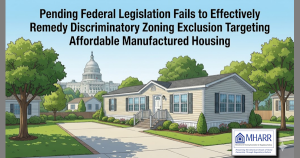
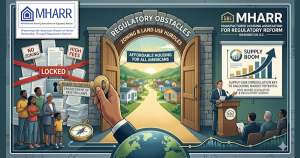
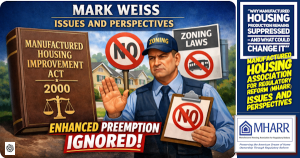
So, while the “housing” bills would address the chassis issue (with a “remedy” that could be problematic in itself, with uncertainties surrounding implementation and enforcement of new chassis rules between HUD and the states, and between HUD and its contractors, who will undoubtedly be encouraged to revert back to their pre-2000 Reform Law habits), they would nevertheless leave the industry exposed to excessive and draconian “energy” standards, they would do nothing to address the long-term failure to serve the manufactured home consumer financing market under DTS, and they would do nothing to address widespread zoning-based exclusion of the industry’s mainstream affordable homes. Again, MHARR has submitted a proposed amendment regarding the enhanced federal preemption of exclusionary and discriminatory zoning, but MHI has not – to MHARR’s knowledge, publicly supported this provision either.
The bottom line with the pending bills is that they represent a sop to the producers of the industry’s highest-cost homes, including so-called “cross-mods” and other designs and installations based on permanent affixation as real estate. By contrast, the bills – as currently constituted and structured – would do little (or nothing) for traditional, affordable, mainstream, non-real estate manufactured homes and their consumers. The bills would allow zoning exclusion (and limitation) to continue without a specific, targeted, mandatory statutory remedy (i.e., a reiteration and clarification of enhanced federal preemption under the 2000 Reform Law). The bills would do nothing to remedy the intentional subversion of the Duty to Serve within the manufactured housing chattel financing market by Fannie Mae and Freddie Mac. And, the bills would leave the industry exposed to excessive and discriminatory “energy” regulation through significant loopholes and overall loose draftsmanship.
Unfortunately, all of the above just represents the tip of the proverbial iceberg regarding the significant deficiencies and major, unexplained omissions of the current housing bills regarding mainstream, HUD-regulated manufactured housing. Indeed, the Wall Street Journal, in a May 26, 2026 editorial, called the House bill a “Bi-Partisan Housing Fiasco.” Perhaps the most important question for the industry is “why is this happening?” Why is an organization – MHI – which claims to represent “all segments” of the industry and a wide-ranging membership, vigorously supporting legislation that will produce only pedestrian benefits for the vast bulk of the industry while propping-up costly high-end designs (and manufacturers) while missing the opportunity to meaningfully address and remedy the main bottlenecks that continue to throttle industry growth on a nationwide basis? The pending bills would be bad laws for the most part that could lead to even worse problems than the industry faces now. They should and must be corrected. And regardless of what comes next, the industry should be asking why MHI would support and advance such deficient – and potentially even harmful – legislation.
MHARR is a Washington, D.C.-based national trade association representing the views and interests of independent producers of federally-regulated manufactured housing.
“MHARR-Issues and Perspectives” is available for re-publication in full (i.e., without alteration or substantive modification) without further permission and with proper attribution and link-back to MHARR.
Featured image generated by AI powered Gemini with human editing of Mark Weiss’ image into the picture.