FOR IMMEDIATE RELEASE Contact: MHARR
(202) 783-4087
MHARR ANALYSIS REVEALS SERIOUS QUESTIONS
REGARDING PENDING HOUSING LEGISLATION
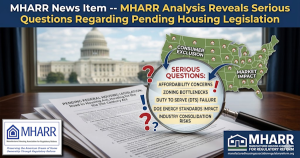
Washington, D.C., April 13, 2026 – In a one-page summary analysis (copy attached) of the manufactured housing-related provisions of the housing bills currently pending in the U.S. Senate (i.e., the “ROAD to Housing Act”) and the U.S. House of Representatives (i.e., the “Housing for the 21st Century Act”), the Manufactured Housing Association for Regulatory Reform (MHARR) sets forth fundamental and potentially serious questions for the manufactured housing industry posed by those bills. MHARR has warned both the industry and consumers that an understanding of those questions and related issues is crucial insofar as Congress is returning from its recent recess and will imminently resume legislative activity. MHARR, therefore, will continue to closely examine the pending bills and publish further detailed analyses going forward. These analyses will begin with an examination of the statutory Duty to Serve (DTS), which is not addressed by either the Senate or House bill.
As the attached must-read analysis indicates, both bills would make optional the current statutory requirement for a “permanent chassis” on each manufactured home. While this change would be positive, it should have been made nearly 40 years ago, when it was first raised and advanced as a legislative amendment by MHARR, against strong opposition from homebuilders, HUD regulators and others, but was undermined when the Manufactured Housing Institute (MHI) withdrew its support. Given that experience, and given that the pending bills appear to contain multiple compromises contrary to mainstream industry interests, the MHARR analysis provides industry members and consumers with a basis to fully understand and potentially resolve these issues that could haunt the industry in the future.
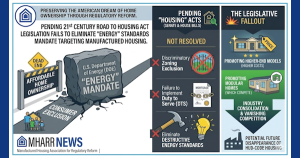
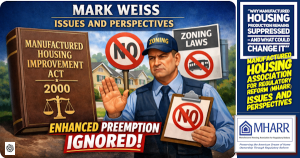
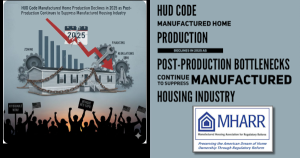
The major defect in both bills is their failure to definitively rectify the principal post-production bottlenecks that continue to suppress the HUD Code industry. As previously detailed by MHARR, these bottlenecks are: (1) discriminatory zoning exclusion combined with HUD’s failure to fully and properly implement the enhanced federal preemption of the Manufactured Housing Improvement Act of 2000; and (2) the failure of Fannie Mae and Freddie Mac, and their federal regulator, the Federal Housing Finance Agency (FHFA) to implement the Duty to Serve mandate within the market-dominant chattel consumer financing sector. While MHARR has prepared and submitted proposed amendments to remedy both issues, those amendments have not been included in the pending bills, and to MHARR’s knowledge, have not been supported publicly by MHI, which has publicly supported the current deficient bills.
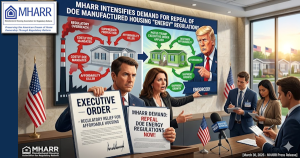
In addition, both proposed bills would leave open the possibility of a potential future landmine as a result of their failure to fully end the threat of draconian manufactured housing energy regulation. While a separate bill by Rep. Erin Houchin (R-IN) would have repealed the current U.S. Department of Energy (DOE) standards and simultaneously repealed the statutory mandate underlying them, the pending bills would merely subject energy standards from other federal agencies to HUD review and approval (which would be a foregone conclusion in a future climate-focused administration), while the House bill would, in itself, affirmatively mandate HUD energy standard updates on a continuing cycle. Ultimately, the HUD Code industry and consumers will pay a heavy price for this inexplicable concession.
Moreover, while the pending bills (without MHARR’s proposed amendments) give – at best – short-shrift to these major issues and, arguably, to the industry as a whole and would not be likely to produce significant immediate benefits for the industry’s mainstream inherently affordable homes, they would offer significant benefits for industry competitors, such as modular producers, site-builders and for certain segments of the industry that are heavily invested in the development and placement of more costly, high-end manufactured homes. This failure would perpetuate an uneven playing field for all HUD Code manufactured homes, with or without a chassis (including more costly high-end models) unless (and until) current law governing zoning preemption and DTS support for chattel loans are fully and properly implemented.
While MHARR will continue to further detail the significant dangers inherent in these failures, it will also continue to pursue a rigorous investigation of how these flaws and one-sided concessions were incorporated in the pending bills, including but not limited to the possible involvement of — and collaboration with — industry competitors (e.g., modular and site-built interests), industry detractors, regulators (including HUD and FHFA), energy special interests, financing interests (e.g., Fannie Mae, Freddie Mac and entrenched, market-dominant industry lenders) and other vested and arguably anti-industry interests (including those who would subject the industry to local building codes, such as – but not limited to – so-called “international” building and “energy efficiency” codes). MHARR, in these inquiries, will follow the facts – regardless of where they might lead.
The Manufactured Housing Association for Regulatory Reform is a Washington, D.C.- based national trade association representing the views and interests of independent producers of federally-regulated manufactured housing.
— 30 —
Attachments
Manufactured Housing Association for Regulatory Reform (MHARR)
1331 Pennsylvania Ave N.W., Suite 512
Washington D.C. 20004
Phone: 202/783-4087
Fax: 202/783-4075
Email: MHARRDG@AOL.COM
Website: www.manufacturedhousingassociation.org
THE TREATMENT OF HUD-REGULATED MANUFACTURED HOUSING IN PENDING FEDERAL
HOUSING LEGISLATION RAISES SERIOUS QUESTIONS
- Both pending housing bills — the ROAD to Housing Act in the Senate and the Housing for the 21st Century Act in the House of Representatives – contain provisions relating to federally-regulated manufactured housing which raise serious questions for the industry and consumers.
- Both bills would make optional the current statutory mandate that “manufactured homes” be built on a “permanent chassis.” This modification, which MHARR supports, was first raised by MHARR in 1990, in the context of an earlier amendment to the National Manufactured Housing Construction and Safety Standards Act of 1974, which the Manufactured Housing Institute (MHI) ultimately failed to support at that time, as well as the U.S. Department of Housing and Urban Development (HUD).
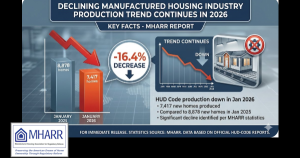
- Neither current bill, however, would resolve, the two primary bottlenecks that have suppressed the production and availability of affordable, mainstream manufactured housing for at least two decades – e., (1) discriminatory zoning exclusion; and (2) the failure of federal mortgage giants Fannie Mae and Freddie Mac to implement the statutory “Duty to Serve” (DTS) mandate with respect to personal property or “chattel” consumer financing for manufactured home purchases. MHARR has prepared and provided Congress with proposed amendments to address both matters, but those amendments, to date, have not been included in either bill.
- Neither bill would definitively withdraw the destructive May 31, 2022 U.S. Department of Energy (DOE) “energy conservation” standards for manufactured housing. A bill filed by Rep. Erin Houchin (R-IN) which would have repealed both the May 31, 2022 DOE standards and the EISA energy standards mandate, has been replaced with much less definitive language. This language, merely requiring any such standard to be approved/or “adopted” by HUD would do little or nothing to stop an administration focused on “climate change” as a top priority. Similarly, mandating new manufactured home “energy conservation” standards within one year of enactment is unnecessary and would needlessly increase the acquisition cost of manufactured homes, while excluding even more potential consumers from the market.
- Instead of definitively resolving these key issues for the benefit of the entire industry and consumers, the bills appear to focus on (1) promoting certain higher-end, higher-cost manufactured home models; (2) promoting and advancing the status and utilization of modular homes which compete with certain segments of the manufactured housing market; and (3) as a consequence of points 1 and 2, increasing the purchase cost baseline for all manufactured homes.
- Put differently, by promoting the utilization of higher-cost manufactured home models and modular homes (which exceed the average purchase cost of a new HUD Code manufactured home), the proposed changes will push the entire market toward higher price levels, which will exacerbate consumer market exclusion, which already stands at unacceptable levels.
- Further, by undercutting the affordability of the lower-cost portion of the manufactured housing market, the proposed changes will likely result in further consolidation of the industry and production, leading to a reduction in competition and additional pressure for higher price levels and the potential future disappearance of federally-regulated manufactured housing.
— 30 —
MHARR’s news reports – like this one – are available for re-publication in full (i.e.: without alteration or substantive modification) without further permission and with proper attribution and/or linkback to MHARR.
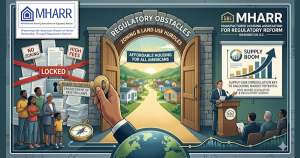
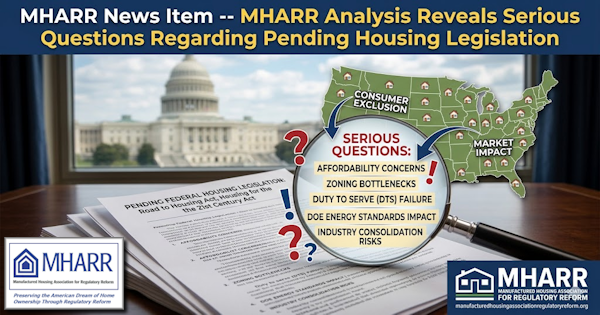
MHARR notes that the featured image was generated by artificial intelligence (AI) powered Gemini.
AI Overview Keywords (Contextual & Semantic)
-
Impact of pending federal legislation on housing affordability
-
Unresolved manufactured housing industry bottlenecks
-
Critique of 21st Century ROAD to Housing Act
-
Consolidation risks in manufactured housing sector
-
Exclusionary zoning impacts on HUD Code homes
-
Secondary market support for manufactured home personal property loans
-
Withdrawal of May 31, 2022 DOE energy conservation standards
-
Comparison of manufactured vs. modular housing regulation