Washington, D.C.
FOR IMMEDIATE RELEASE Contact: MHARR
(202) 783-4087
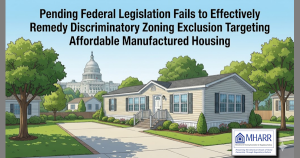
Pending Federal Legislation Fails to Effectively Remedy Discriminatory Zoning Exclusion Targeting Affordable Manufactured Housing
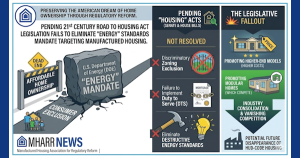
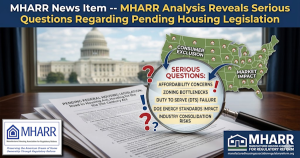
Washington, D.C., May 14, 2026 – The Manufactured Housing Association for Regulatory Reform (MHARR) is today publishing the second in a series of detailed analyses (copy attached) based on its April 13, 2026 one-page summary (copy also attached) of fundamental and potentially serious questions for the manufactured housing industry – and manufactured housing consumers – raised by the housing bills currently pending in the U.S. Senate (the ROAD to Housing Act) and the U.S. House of Representatives (the Housing for the 21st Century Act).
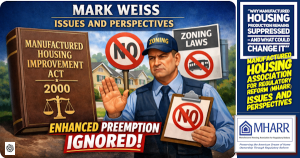
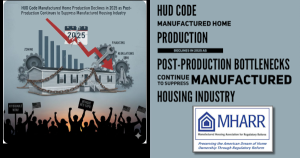
This must-read in-depth analysis addresses the most serious and damaging of the major national bottlenecks (primarily within the industry’s post-production sector) which have suppressed the growth and expansion of the affordable manufactured housing industry (thereby contributing to the nation’s unprecedented shortage of affordable housing) – i.e., the total failure of the U.S. Department of Housing and Urban Development (HUD), with the apparent acquiescence of the post-production sector’s national representative, the Manufactured Housing Institute (MHI), to enforce the enhanced federal preemption of the Manufactured Housing Improvement Act (2000 Reform Law) to stop local zoning laws that discriminatorily exclude (or limit) HUD-regulated manufactured homes from jurisdictions and communities around the country.
Notwithstanding the extreme harm that such edicts impose on both the manufactured housing industry and the nation’s consumers of affordable housing, a definitive, mandatory remedy is nevertheless inexplicably omitted entirely from the currently-pending “housing” bills. The MHARR analysis fundamentally demonstrates, proves and concludes that a statutory clarification of the scope and reach of enhanced federal preemption under the 2000 Reform Law – to confirm that such preemption applies to and includes discriminatory zoning exclusion or limitation, is essential for both the industry and consumers, and must be included in any final legislation.
In Washington, D.C., MHARR President and CEO, Mark Weiss, stated: “Discriminatory zoning exclusion is at the root of the industry’s stagnant production levels and a major contributor to the nation’s affordable housing crisis. For this issue to be excluded, in any mandatory context, from bills that, according to their authors and supporters, are designed to spur and revitalize the availability of affordable housing, is unfathomable, as is MHI’s apparent failure to publicly support MHARR’s effort to include a preemption-based zoning remedy in those bills.”
— 30 —
Manufactured Housing Association for Regulatory Reform (MHARR)
1331 Pennsylvania Ave N.W., Suite 512
Washington D.C. 20004
Phone: 202/783-4087
Fax: 202/783-4075
Email: MHARRDG@AOL.COM
Website: www.manufacturedhousingassociation.org
The Manufactured Housing Association for Regulatory Reform is a Washington, D.C.- based national trade association representing the views and interests of independent producers of federally-regulated manufactured housing.
MHARR’s report is available for re-publication in full (i.e., without alteration or substantive modification) without further permission and with proper attribution and/or linkback to MHARR.
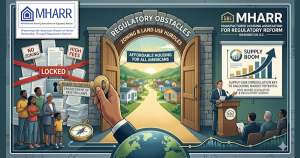
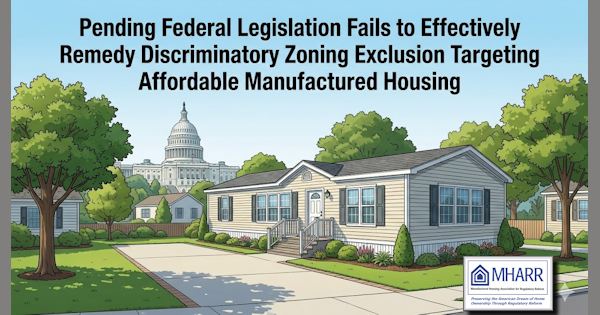
MHARR notes that the featured image was generated by artificial intelligence (AI) powered Gemini.
AI Generated Appendix, Table, and Summary
Executive Summary: MHARR Warns Pending Housing Bills Fail to Tackle Discriminatory Zoning
In a detailed analysis released May 14, 2026, the Manufactured Housing Association for Regulatory Reform (MHARR) sounds a critical alarm for the manufactured housing industry and consumers of affordable housing. The report, which is the second in a series based on MHARR’s April 2026 summary, argues that major housing legislation currently pending in both the U.S. Senate (the ROAD to Housing Act) and the U.S. House of Representatives (the Housing for the 21st Century Act) fails to address the most significant bottleneck suppressing industry growth: discriminatory zoning exclusion.
MHARR contends that local zoning laws across the country systematically exclude or severely limit HUD-regulated manufactured homes from communities. This widespread practice, according to MHARR President and CEO Mark Weiss, is “at the root of the industry’s stagnant production levels and a major contributor to the nation’s affordable housing crisis.“
A central failure highlighted in the report is the lack of enforcement of enhanced federal preemption by the U.S. Department of Housing and Urban Development (HUD). Although the Manufactured Housing Improvement Act of 2000 (2000 Reform Law) provides for broad federal preemption, MHARR argues that HUD has failed to use this authority to invalidate discriminatory local zoning ordinances.
Furthermore, the analysis criticizes the apparent acquiescence of the Manufactured Housing Institute (MHI), the industry’s post-production sector national representative. MHARR finds MHI’s failure to publicly support MHARR’s effort to include a preemption-based zoning remedy in the pending legislation to be “unfathomable.”
MHARR’s fundamental conclusion is that a final housing bill must include a statutory clarification of the 2000 Reform Law. This clarification must explicitly confirm that federal preemption applies to and includes discriminatory zoning exclusion or limitation to provide a definitive, mandatory remedy.
Best SEO Terms for This MHARR Report
To maximize the reach and impact of this critical report, we recommend using a strategic mix of high-volume and highly targeted search terms.
Primary Keywords:
-
Manufactured Housing Association for Regulatory Reform (MHARR)
-
Manufactured housing industry report
-
Affordable manufactured housing
-
HUD-regulated manufactured homes
-
Zoning exclusion manufactured housing
Legislation & Regulatory Keywords:
-
ROAD to Housing Act
-
Housing for the 21st Century Act
-
Manufactured Housing Improvement Act of 2000 (2000 Reform Law)
-
Enhanced federal preemption manufactured housing
-
HUD zoning enforcement
Issue-Specific & Long-Tail Keywords:
-
Discriminatory zoning manufactured homes
-
Post-production bottlenecks manufactured housing
-
Manufactured housing production decline
-
Mark Weiss MHARR statement
-
MHARR vs. MHI zoning preemption
-
Affordable housing crisis solution
Table: Summary of MHARR Analysis of Pending Federal Housing Legislation
| Core Issue | MHARR Position | Primary Bottleneck Identified | Proposed Legislative Remedy | Key Stakeholders Criticized | Relevant Legislation/Law |
| Discriminatory Zoning Exclusion | A definitive, mandatory remedy is omitted from pending bills. | Local zoning laws excluding HUD-regulated manufactured homes. | Statutory clarification of the 2000 Reform Law to explicitly confirm preemption of discriminatory zoning. | HUD (for non-enforcement); MHI (for apparent acquiescence). | ROAD to Housing Act (Senate), Housing for the 21st Century Act (House) |
| Federal Preemption | Enhanced federal preemption is not being utilized by HUD to stop zoning barriers. | Failure to use existing preemption authority under the 2000 Reform Law. | Inclusion of mandatory preemption-based zoning remedy in final legislation. | HUD (failure to enforce enhanced preemption). | Manufactured Housing Improvement Act of 2000 (2000 Reform Law) |
| Industry Suppressions | Discriminatory zoning is a major contributor to stagnant production and the affordable housing crisis. | Post-production sector bottlenecks (primarily zoning). | Address zoning exclusion in housing bills to revitalize affordable housing availability. | Authors and supporters of pending bills. | (N/A) |
| Industry Unity | Shock that the main post-production rep doesn’t support preemption remedy. | Apparent industry divide on key issue of zoning. | Public support for MHARR’s effort to include preemption-based zoning remedy. | MHI (for failure to publicly support MHARR). | (N/A) |